


Blockchain
A blockchain makes it possible to transmit information in a tamper-proof way using a decentralised database shared by many participants, so that copies are excluded. The database is also known as a distributed ledger. It is stored on many computers in a peer-to-peer network (network of computers with equal rights), whereby each new node takes over a complete copy of the blockchain when it joins and from then on has the task of verifying and documenting transactions.
The most important area that the blockchain helps with is primarily to ensure that a transaction is correct. A transaction is not only recorded in a main directory, but in a networked decentralised system of directories, which are all connected via a secure verification mechanism. Moreover, a blockchain cannot be corrupted.
The more data that is added to a blockchain, the more secure it becomes. Since each new block builds on the shared accuracy of the last block, anyone trying to break into the data and fraudulently change it would also have to change all the previous blocks - and all the blocks in the entire network.
Thus, a blockchain solves the problem of manipulation. In summary, validation and data protection are at the heart of blockchain technology.
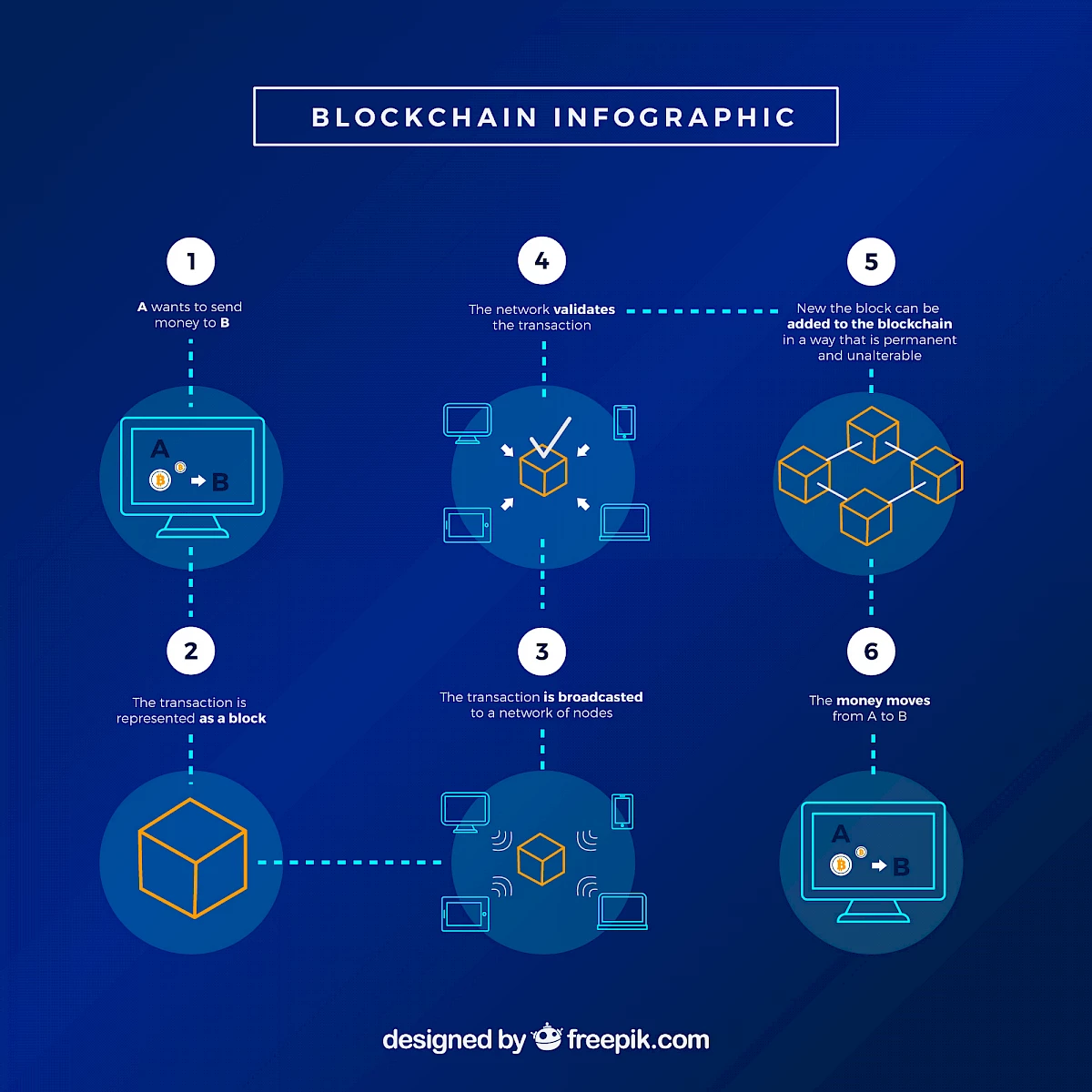 Blockchain explained with an example.
© Infographic vector created by freepik - www.freepik.com
Who is using blockchain technology and for what?
Financial industry
Banks can share parts of a blockchain with each other to track suspicious activity and trace the flow of transactions. Approved blockchains can be used to restructure business processes, such as moving transactions from front to middle to back office, eliminating the need for data reconciliation. Emerging uses include blockchain for trade finance, global payments, securities settlement and commercial real estate.
Transport
Blockchain can help coordinate routes and modes of transport in cities. A Blockchain network can work with buses, cars, bikes, trains and other transport partners to plan the best multimodal route for customers, ensure smooth transitions between vehicles and offer a single payment for users.
Supply Chain
Complex supply chains - and all items within them - can be tracked consistently and securely for all interested parties, including buyers and regulators.
Bitcoin
Cryptocurrency based on a decentralised booking system.
Fight against narcotics abuse
The prescription (eBtM) is digitally managed in a private blockchain by medical practices, pharmacies and regulatory authorities together. In this way, eBtM increases narcotics safety in Germany and reduces administrative costs.
Digital AU
This is securely encrypted and transmitted to the patient, employer and health insurance company. Thanks to the blockchain, AU forgeries are practically impossible.
NFT token
Storage of non-exchangeable tokens on a blockchain.
Smart Contract
A smart contract is a digital contract based on blockchain technology. As a rule, smart contracts are used to automate the legally valid execution of a contract. An intermediary, which is still often necessary today, is no longer needed because all parties involved have immediate certainty about the result. In addition, smart contracts can be used to automate workflows. If a condition is fulfilled, subsequent actions can be triggered automatically.
Blockchain focus group
Digitalradar Münsterland has set up the Blockchain focus group to jointly find an introduction to the technology, design application scenarios and derive business models from them.
Further information is available here:
https://www.digitalradar-muensterland.de/fokusgruppen/blockchain/