More than 1000 organic portions: Canteen at Mathilde-Anneke-Gesamtschule Münster certified organic with the help of the eco-model region
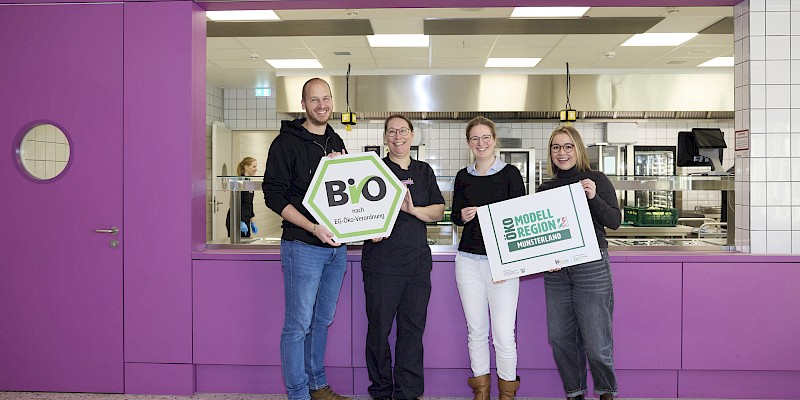
Pupils at Mathilde-Anneke Comprehensive School can now enjoy an organic-certified lunch. The canteen recently passed the organic certification test. The Münsterland eco-model region, based at Münsterland e.V., provided support during the application process for a free "NRW cooks with organic" coaching programme. The aim was to develop strategies to introduce or expand the range of organic food on offer and to achieve organic certification.
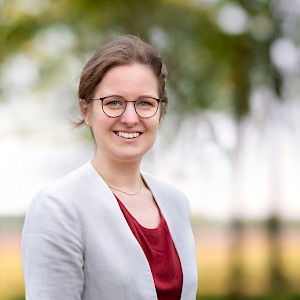
"The organic certification of the canteen is a great success and shows that sustainable school catering is feasible - even with over 1000 meals a day. By working directly with regional organic farms, seasonal menu planning is easily possible. This also has a positive effect on the kitchen budget. For the pupils, this means not only eating healthy and delicious food, but also supporting farms in their neighbourhood," says Juliane Rabe, project manager of the Münsterland eco-model region (ÖMR). This promotes organic farming in the four Münsterland districts and the city of Münster and also offers an extensive network of companies and farms. The ÖMR supported the association during the application phase and throughout the rest of the application process. The "NRW cooks with organic" project included several group and individual coaching sessions as well as reciprocal visits to the kitchens of the six other participants. Jutta Höper, Head of Sustainability at the City of Münster, also emphasises: "Our experience as the organic city of Münster has shown that sharing ideas with other kitchens as well as with regional producers is an essential key to sustainable catering."
The Mathilde-Anneke comprehensive school in Münster developed a desire for healthy food and sustainable school catering. The "Schmackofatz" canteen has been firmly anchored in school life for years. Pupils, teachers and parents are actively involved - for example in initiatives against food waste. The canteen association was founded. Its board consists of two teachers and two parents who are involved on a voluntary basis. Motivated by this, the school, together with the support of the eco-model region, applied for "NRW kocht mit Bio" and the subsequent organic certification. The main challenge in switching to organic food was the logistics. The ten-strong canteen team prepares an average of more than 1000 fresh meals every day. Thanks to the expansion to eight regional suppliers and flexible menu planning, the children and young people now eat meals with regional foods, among other things.
Meike Schlautmann, kitchen manager of the Mathilde-Anneke-Gesamtschule canteen, says: "Our canteen is an impressive example of how good school catering and sustainability can go hand in hand. We are particularly pleased that this concept is also so well received by the pupils. Stephan Häming, member of the board of the canteen association, adds: "The successful collaboration between all those involved at Mathilde-Anneke-Gesamtschule shows how sustainable changes can be implemented in everyday school life. We are very proud of this." The work of the association and the school continues. In future, further regional partner companies are to be acquired and food waste reduced even further.
In addition to the canteen association, six other canteens and kitchens were trained - including ABH OHG - Event- und Gastroservice, operator of the canteen at the district hall in Borken, also from ÖMR Münsterland. The Ministry of Agriculture and Consumer Protection NRW supports the ÖMR and the coaching.
About the Münsterland eco-model region
The four districts of Münsterland and the city of Münster work together with the NRW Chamber of Agriculture and the Leader regions in the joint project "Öko-Modellregion Münsterland". Under the leadership of Münsterland e.V., the project aims to increase the proportion of bioregionally produced products in the fields, on supermarket shelves, on canteen plates and in shopping baskets. The project is funded by the Ministry of Agriculture and Consumer Protection of the state of North Rhine-Westphalia.