


Business Analytics (BA)
Business analytics is an extension of business intelligence.
Business intelligence is characterised by the fact that historical data is viewed(backwards). This is in the area of descriptive analytics. In addition, BI aims to clarify the question of why certain results were achieved. This is in the area of diagnostic analytics.
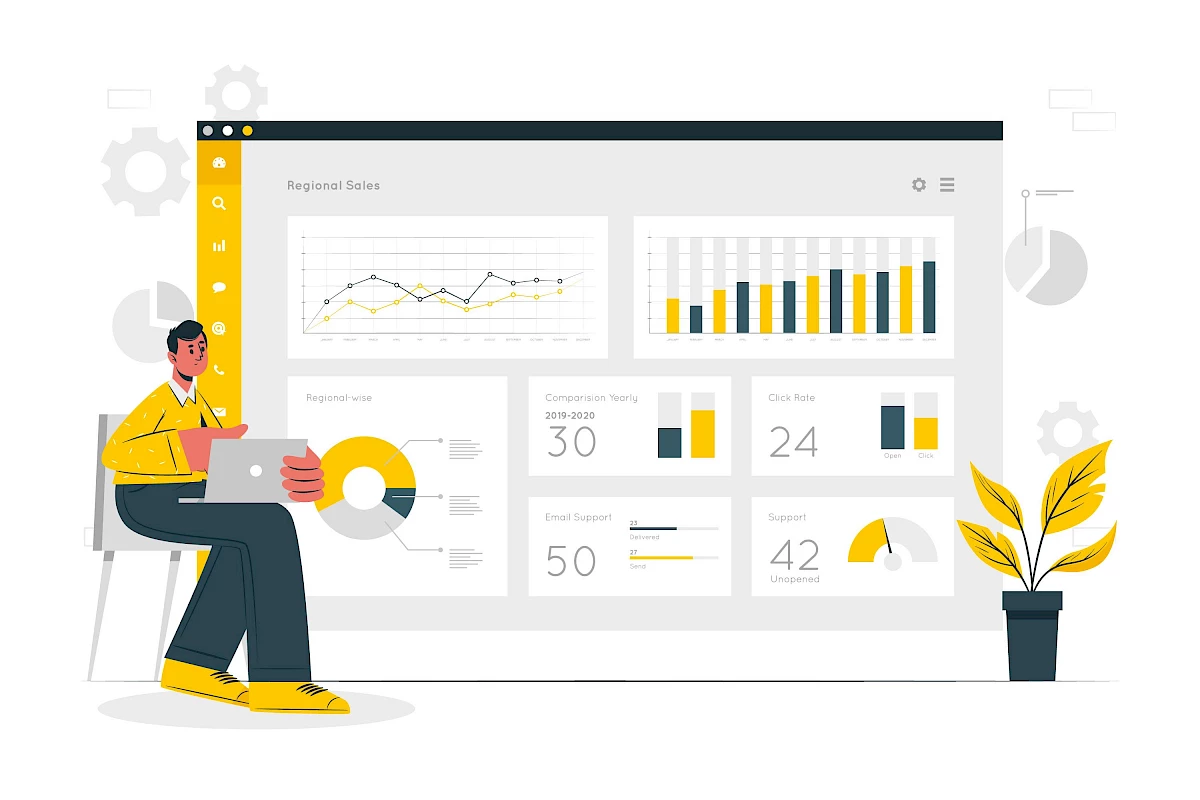 A man is sitting on a chair with a laptop. In the background, the dashboard on his screen is enlarged.
© a_href_httpswww_freepik_comvectorsbusinessbusiness_vector_created_by_stories_-_www_freepik_coma
Business analytics, on the other hand, builds on the historical data but tries to answer other questions. The view is directed into the future when applying BA. It is about calculating the probability of the occurrence of a certain circumstance on the basis of historical data. This is in the area of predictive analytics, which is closely linked to the use of artificial intelligence methods. In addition, BA wants to answer the question of which steps are necessary to achieve a certain target (prescriptive analytics). In this way, BA can provide users with recommendations for action.
The goal is to make new insights from the treasure trove of data available to companies in an automated way.
In other words:
"Business analytics (BA) describes the application of mathematical and statistical methods to gain new insights into the business" (Ereth & Kemper, 2016, p. 458). In this process, classic methods that analyse existing data are supplemented with the use of new technologies to make predictions about the future and provide recommendations for action (Derwisch, Iffert, Fuchs & Bange, 2016, p. 480).