


Exoskeletons
Exoskeleton is the extension of the human body by mechanical components. In this way, human forces are multiplied to extend or enable task areas. This supports human work performance in terms of health, ergonomics and performance. There are various possibilities of support. Depending on the area of application, individual joints, limbs or the entire body can be relieved.
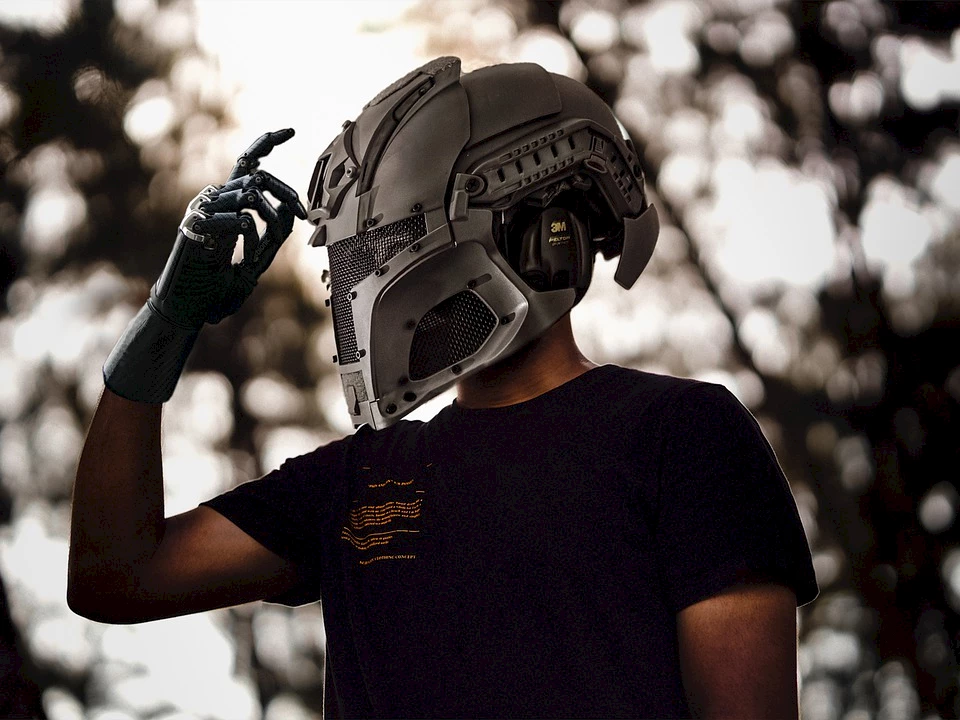 Exoskeleton
© https://pixabay.com/de/photos/cyborg-roboter-helm-metallisch-6604411/
Prerequisites for use
Risk assessment
According to the Occupational Health and Safety Act, in order to avoid hazards to the safety and health of employees, the employer is obliged to carry out a risk assessment. Hazards are to be identified and assessed in order to derive effective protective measures.
Analysis of the area of application
Exoskeletons are particularly suitable for non-stationary workplaces when the use of forklifts, cranes, etc. is not possible. Stationary workplaces can be ergonomically designed and equipped with conventional aids to relieve the strain on people.