From smart care to the circular economy: think tank members network and kick off ideas
Meeting of the members of all Münsterland think tanks of Enabling Networks Münsterland.
Topics such as health, digitalisation and the circular economy do not only play a role in one sector of the economy - on the contrary. They affect a wide range of sectors, are often interlinked and mutually dependent. On Tuesday, around 35 representatives from business, science and networks met in Münsterland to exchange ideas, network and explore potentials for the Münsterland. They are all members of one of the five think tanks of the joint project Enabling Networks Münsterland and now came together for the first time for a joint meeting at the M44 Meeting Center in Münster.
"Within the think tanks, there was always a desire to get to know each other. Because there are exciting cross-connections between the topics discussed in the individual think tanks. At the same time, the members benefit from the exchange of knowledge and the network and can initiate possible cooperations," emphasised Bernd Büdding, head of the Enabling Networks Münsterland project at Münsterland e.V.
In workshops, those present exchanged ideas on three central cooperation approaches in the region: "Smart Care Platform Münsterland", "Digital Working Worlds in Production" and "Circular Economy Region Münsterland". They discussed the sense and benefits of these ideas and talked about possible improvements and future plans.
Under the heading "Smart Care", the speakers Dr. Kathleen Spring and Dr. Klaus-Michael Weltring from the Gesellschaft für Bioanalytik Münster e.V. (Society for Bioanalytics Münster) discussed, among other things, the idea of a special platform for the region: on the one hand, this could inquire about the needs of medical professionals for technological applications, and on the other hand, it could present possible solution providers from technological fields. For especially in health care, the use of artificial intelligence, sensor technology and digital aids could be an important building block for relieving staff and improving diagnostics for patients.
Exciting discussions also developed in the workshop "Kreislauswirtschaftsregion Münsterland" with speakers Bernd Büdding (Münsterland e.V.) and Gotthard Walter (IWARU, Münster University of Applied Sciences). The participants drafted and evaluated ideas for bundling offers for companies and citizens in the field of circular economy and considered how the topic can be anchored in the minds of companies and people. "We have in mind a network centre that promotes the topic in the Münsterland region, networks actors, builds capacities and creates added value," Bernd Büdding emphasised. "Especially against the background of sustainability. Because the lower the use of resources, the lower the CO2 emissions."
With the speakers Lukas Rengbers (TAFH Münster GmbH) and Christopher Langner (Westfälische Hochschule), the participants discussed the topic of "Digital working worlds of the future in production". The focus was also on raising awareness among employees and future skilled workers. How can we get them excited about the use of augmented and virtual reality in the workplace? Because only with their acceptance will it be possible for employees to maintain machines remotely with data glasses or work side by side with robots in the future.
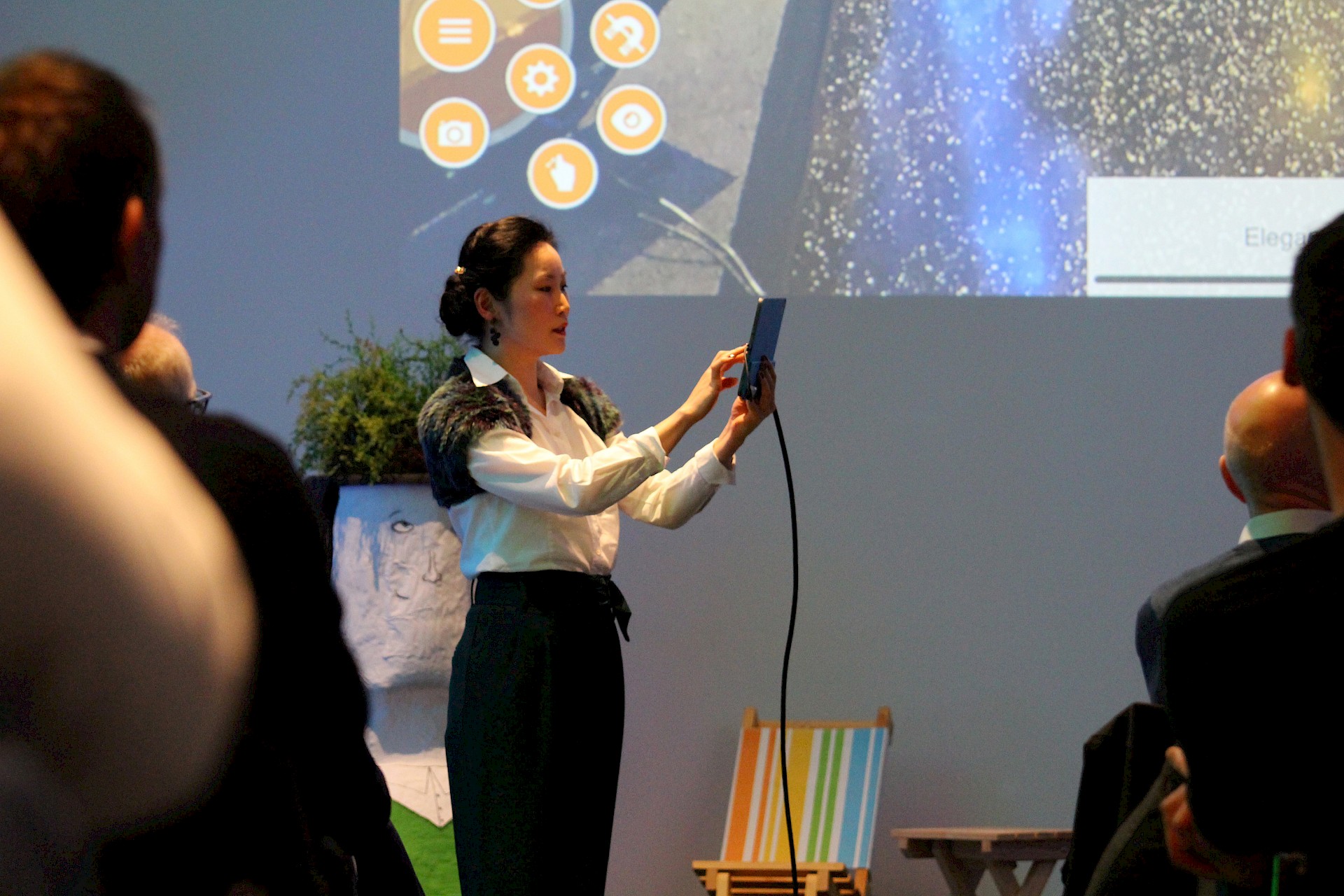
Just a short time later, Bernd and Berenice Terwey from AVK TERWEY in Emsdetten showed the possibilities that already exist for using AR and VR in companies. They have already developed corresponding applications for numerous companies in Münsterland and presented them via iPad and screen. For example, digital shoes can be conveniently put on and selected at home.
The next few months will also be exciting for the members of the Münsterland think tanks. Together they will travel to innovative places in Germany and neighbouring countries and discover, for example, the Holst Centre in Eindhoven in the Netherlands, an independent research and innovation centre. With these inspirations and impressions in mind, they then jointly develop recommendations for action for the region.